The Short Story
Tips and Tricks and Useful Info
Why We Apply Trust-Based Marketing to Every Client
There is a category of business we have spent more than twenty years learning to serve. Businesses where the relationship has to be established before the sale can happen. Where a prospective client is not just evaluating your services. They are evaluating you. Your judgment. Your values. Whether you are genuinely the right person to trust with something that matters.
We call them trust-based businesses. Independent educational consultants. Financial advisors. Therapists. Estate planning attorneys. Nonprofits asking donors to believe in a cause they may never personally benefit from.
But here is something we have quietly learned along the way: the framework we built for those clients does not stay in its lane.
The Problem With Transactional
When a new client comes to us outside our traditional trust-based niche, a local retailer, a product-focused company, a service business built on volume rather than relationship, there is a temptation to shift gears. To apply a different playbook. To think: these folks just need traffic and conversions. Let us optimize the funnel.
That is a reasonable instinct. But it is the wrong one.
What we have found, over and over, is that the methodology we use for a family law attorney or a college counselor, the deep listening, the emphasis on earned credibility, the obsession with what a visitor feels before they ever make contact, all of it produces better results for every client. Even the ones selling widgets.
Trust is not a niche. It is a standard.
What the Trust-Based Framework Actually Is
At its core, our approach to trust-based marketing rests on a single observation: people rarely leap. They step. A click. A quick read. A first impression that quietly signals, you are in the right place. Our job is to engineer those moments, and to make sure each one leads naturally to the next.
The framework centers on five interconnected practices: leading with identity rather than inventory, elevating human narrative over anonymous crowd proof, surfacing a client's underlying philosophy instead of defaulting to price-driven messaging, building radical transparency into every touchpoint, and creating the conditions for genuine community, not just conversion.
[Read more about our trust-based methodology]
What This Looks Like in Practice
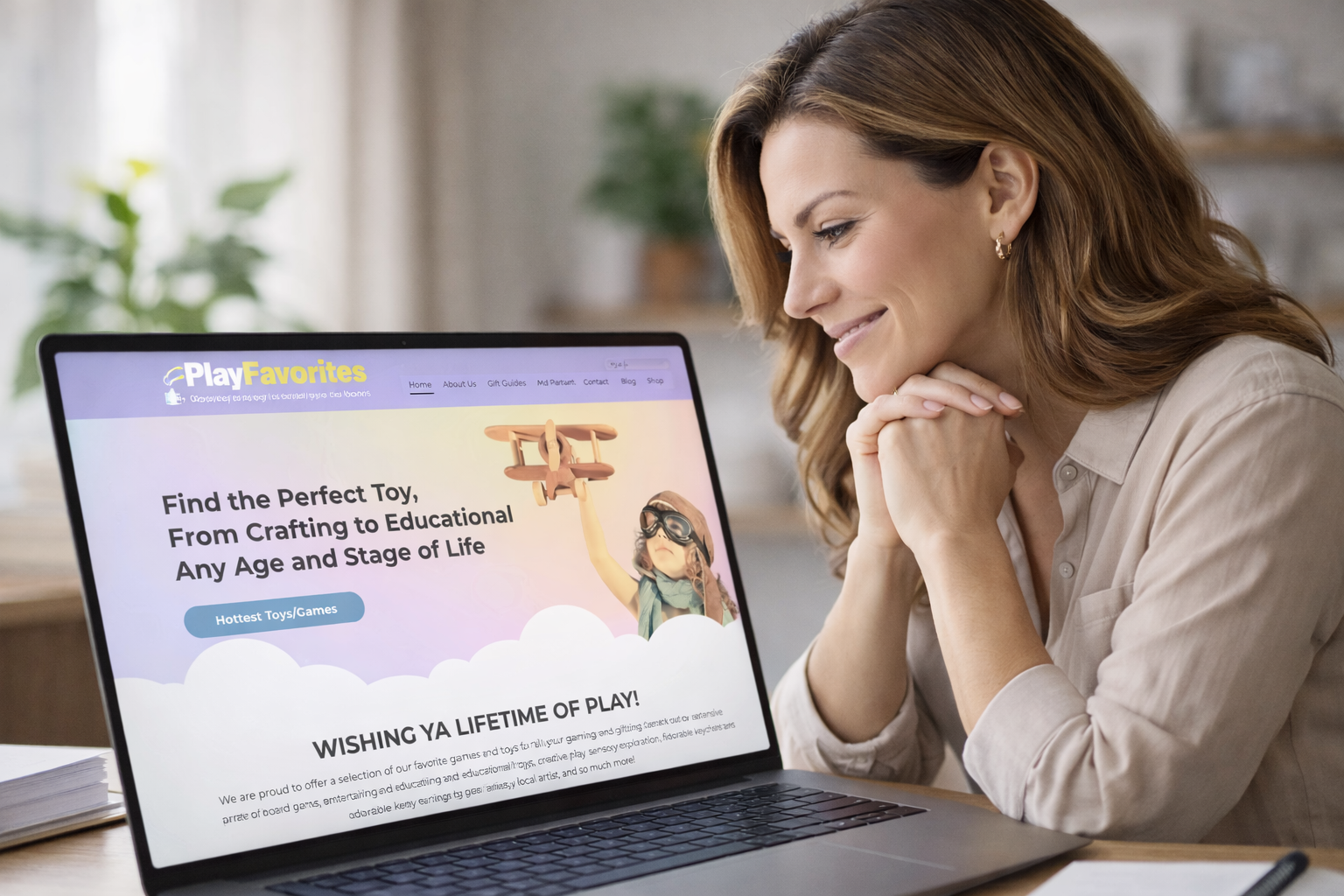
A few years ago, we built a website for a local toy and game store, about as far from a trust-based professional services firm as you can get. Retail. Physical products. A shopping center storefront.
We applied the same framework anyway.
Working closely with the owners, we agreed early on not to organize the homepage around product categories. Instead, we shaped it together around identities: homeschooling families, seniors who never stopped playing, parents planning their child's first birthday party in a space that actually felt welcoming. Rather than leading with a discount banner, we opened with a philosophy the client already lived by: Wishing you a lifetime of play. “Shop” is in the last position in the navigation, after About, Gift Guides, Play Room, and Contact. A quiet but meaningful signal about what kind of place this was.
We published the party room rates, the house rules, and the cancellation policy. We told the story of a local biology teacher who started making science-themed earrings when she could not find a pair to match her lesson on salamanders. We built out a weekly event calendar of free game nights, arcade hours for kids, and collaborative sessions for game designers, all of it positioning the store as a community anchor, not just a retail destination.
The strategic direction came out of those early conversations. What has been gratifying to watch is how naturally the client took ownership of it, continuing to build on that community-first identity and make it unmistakably their own. The store's voice, its event programming, its relationship with regulars: all of it has grown organically from the foundation we built together.
The result was a website that did not feel like a store. It felt like a place you had already decided to trust before you ever walked in.
That is the point.
The Strategic Case for Bringing Trust to Every Project
Here is why this matters practically, not just philosophically.
A transactional approach built on optimized landing pages, retargeting ads, discount mechanics, and conversion funnels can generate a first purchase. What it cannot generate is a second one, a referral, or a relationship. Customers acquired through urgency and incentive are loyal to the deal, not the brand. The moment a competitor offers a better discount, they are gone. That is not a customer base. That is a leaky bucket with a paid media pump keeping it full.
Loyalty is built differently. It is built in the space between transactions, in the accumulated weight of a dozen small signals that tell a customer: this business sees me, understands me, and deserves my continued trust. The tone of the copy. The order of the navigation. The presence of a real story. The absence of artificial urgency. None of those things close a sale by themselves. Together, they create the conditions in which people choose to stay.
This is why our trust-based methodology is not a specialty we apply selectively. It is the strategic lens through which we approach every project. When we bring it to a client who does not think they need it, we are not over-engineering a simple project. We are addressing the one gap that keeps even well-performing businesses stuck in the acquisition treadmill: the absence of a reason for customers to come back, to refer others, and to stop looking at competitors.
Trust is the only loyalty mechanism that compounds. And it is available to every business willing to earn it.
When we apply trust-based thinking to a client who does not think they need it, we are giving that client a competitive advantage most of their industry peers do not have and do not know they are missing.
And we are doing the kind of work we are proud to put our name on.
Trust Is the Methodology
We built our practice around a specific kind of client. But the framework we built to serve them turns out to be the right framework for every client we work with, because at the end of the day, every business lives or dies by the quality of the relationships it builds.
Transactions keep the lights on. Relationships keep the business alive.
Whether your clients are choosing you once, or choosing you every year for the rest of their working life, the question they are always answering is the same one.
Can I trust these people?
The businesses that answer that question convincingly, before anyone has to ask it, do not need to fight as hard for every sale, discount as deeply to close a deal, or spend as much to replace the customers they quietly lose. They have something better: a reputation that does the selling for them.
We have spent twenty years learning how to build that. And we bring it to every project, regardless of the industry on the brief.
Short Story Marketing helps trust-based businesses and growth-minded companies build websites, content, and digital presences that earn confidence rather than just claim it. Get in touch.