The Short Story
Tips and Tricks and Useful Info
Why So Much AI Visibility Advice Misses the Point
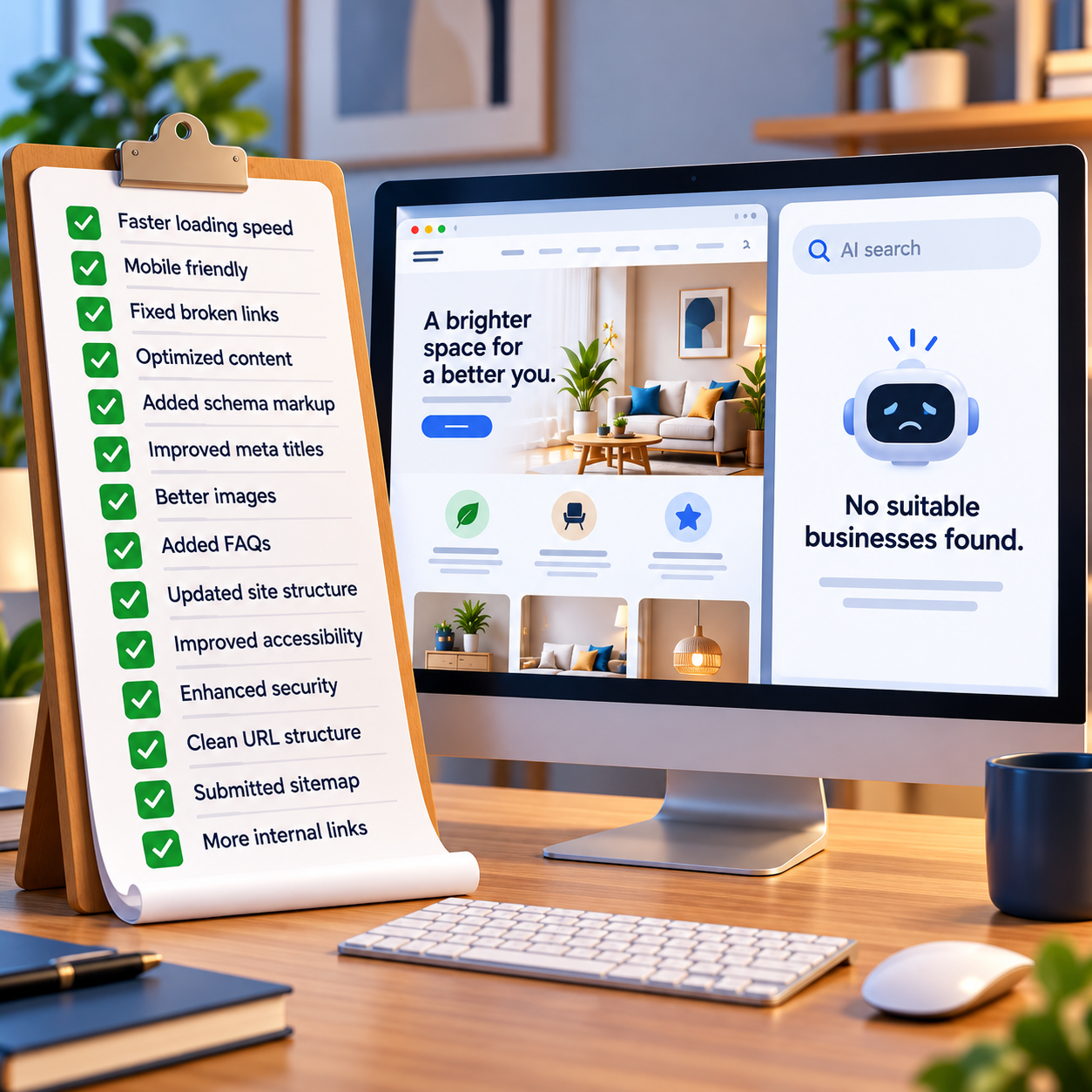
You could spend many hours and hundreds or even thousands of dollars improving your website's AI search visibility, and still get overlooked when potential customers ask ChatGPT to recommend a business like yours.
Worse, you might be spending that time and money fixing the wrong things.
If you've asked ChatGPT or Claude to review your website, you've probably received a very impressive list of recommendations: Add FAQs. Update technical settings. Improve page titles. Publish more content. Get mentioned on other websites.
It looks thorough. It sounds authoritative. And much of it may be perfectly reasonable.
But here's what that review may miss: AI can evaluate the information on your website, but it doesn't necessarily know what important information is missing.
It doesn't know about the conversations you've had with customers, the special situations you're particularly good at handling, or the reasons people choose you over competitors.
Unless you tell it.
And those missing details may matter far more than anything on its technical checklist.
Getting Everything Right Except the Message
Imagine spending hours writing a business letter. You check every comma, eliminate grammatical errors, choose the perfect font, and make sure the margins are exactly right.
Then you mail it.
Unfortunately, the recipient can't figure out what you're trying to say.
Congratulations. You've written a grammatically perfect letter that accomplishes absolutely nothing.
That's essentially what can happen with an AI website review. It may do a terrific job identifying technical problems and suggesting standard improvements while completely missing what your website should be communicating in the first place.
What Most AI Visibility Audits Overlook
One of our favorite digital marketing experts recently reviewed 150 articles offering advice about improving AI search visibility.
The recommendations were remarkably consistent. Nearly everyone suggested adding FAQs, technical markup, outside references, or more content.
None of those are necessarily bad ideas.
But they overlook something more fundamental.
Does your website clearly explain what you do, who you serve, and why someone should choose you?
Auditing the Audits: Surprising New Research
Just last week (late October 2026), he followed up his original research by examining 100 publicly promoted AI visibility audits to see what they actually evaluate.
The findings were revealing.
Only 3% considered the types of customers a business was trying to reach. That means 97% didn't!
Many of the audits also generated their test questions from the website itself, overlooking the very customer questions the website fails to answer.
That's a serious limitation. If your website is missing important information about your services or customers, how can the tools possibly discover what's missing, and how to fix it?.
If you ask ChatGPT or Claude to evaluate your website, it's not surprising that the advice can be incomplete or misleading. After all, those tools generally start with whatever information they can find.
But you might reasonably expect more from a specialized AI visibility audit, particularly one promoted as a way to evaluate how well your business appears in AI recommendations.
Unfortunately, many of those audits appear to have the same fundamental weakness. They evaluate what's already there without adequately considering what your customers actually need to know.
And that's a problem no technical score can solve.
AI Can't Recommend What It Doesn't Understand
Consider an independent educational consultant who helps families navigate college admissions.
Ask an AI tool how to improve the consultant's website, and it might recommend adding FAQs about application deadlines, financial aid, standardized testing, and college essays.
Perfectly reasonable questions. And probably the same ones appearing on hundreds of other consultants' websites.
But what if prospective clients are actually asking whether the consultant works with students who have learning differences? Or whether they help families whose students have good grades but no idea what they want to study?
Those questions could be much more important to the business.
And unless the website already mentions those specialties, how would an AI tool reviewing the site even know to ask about them?
It might recommend another ten FAQs about college admissions while missing the very information that could help a family choose that consultant.
That's a much more serious omission than a missing page title or an imperfect technical setting.
Start With What Customers Actually Want to Know
This is where we approach AI search visibility differently.
Rather than beginning with a technical checklist, we start by understanding your business, your customers, and the situations that lead them to search for someone like you.
We start with what AI can learn from your website, then work with you to verify what it gets right, correct what it gets wrong, and identify important details it may be missing.
We work with you to develop realistic questions your prospective customers might ask ChatGPT, Claude, Gemini, or other AI tools. We also consider what matters to those customers when choosing between you and a competitor.
Then we test those questions to see which businesses AI recommends to potential customers like yours, and where your business is being overlooked.
Along the way, we look at questions such as:
- Does your homepage clearly explain who you help and what you offer?
- Does your website address the specific situations that bring customers to you?
- Does it explain what makes you different from competitors?
- Are important answers easy to find, or buried several pages deep?
- What information could help AI recognize when your business is a particularly good match for someone's needs?
From there, we identify specific improvements that could make your website more useful to prospective customers and help AI better understand when to recommend your business.
The difference is that we're not simply asking AI what's wrong with your website. We're helping determine what your website needs to communicate in the first place.
Fix the Message Before You Fix the Formatting
We're not suggesting you ignore technical improvements, FAQs, or mentions on other websites. Those can all contribute to better visibility.
But they shouldn't automatically be your starting point.
Our approach is to understand your customers first, examine what AI currently knows about your business, and identify where important information is missing or unclear.
Then we can concentrate on the changes that are most likely to matter.
Sometimes the most valuable improvement is adding a few sentences that clearly explain an important service or specialty your website never mentioned.
There's another benefit. Making your website clearer for AI can also help traditional search engines and actual human visitors.
Before spending money making your website more appealing to AI, make sure it tells your story clearly.
Perfect grammar won't save a letter nobody understands. Neither will perfect technical settings save a website that doesn't explain your business.
If you're wondering why AI recommends your competitors but rarely mentions you, let's talk.
Further reading:
What SEOs Get Wrong About AI Search
We Audited 100 AI Visibility Audits. Here's What They Miss